Next.js App Starter (App Router)
The Next.js App Starter spins up a blank, high-quality Next.js 14+ project that is ready to ship:
- App Router with TypeScript and strict mode
- Tailwind CSS + Ignix design tokens +
ThemeProviderwrapper - Hot Module Replacement (HMR) on
npm run dev - ESLint (
next/core-web-vitals) & Prettier (Tailwind plugin) configs - Git initialized with sensible
.gitignore - Pre-built
src/structure (app,components,pages,styles) - Lighthouse-friendly defaults (optimized fonts, strict mode, SWC minify)
Use this starter when you need a clean Next.js canvas that already speaks Ignix UI.
Installation Methods
- npm
- Yarn
- npx
npm install -g @mindfiredigital/ignix-cli
yarn global add @mindfiredigital/ignix-cli
npx @mindfiredigital/ignix-cli
Usage Modes
- Interactive
- Direct
Run the CLI and choose Starters Template → Next.js App (App Router + TypeScript + Tailwind):
ignix
The interactive mode provides a beautiful, guided interface with the following options:
- 🚀 Initialize Ignix UI - Set up your project
- ➕ Add components - Add components to your project
- 📋 List components - View available components
- 🎨 Manage themes - Configure and manage themes
- 📦 Starters Template - Generate a new starter template
- 🚪 Exit - Close the CLI
Choose the option Starters Template and press Enter.
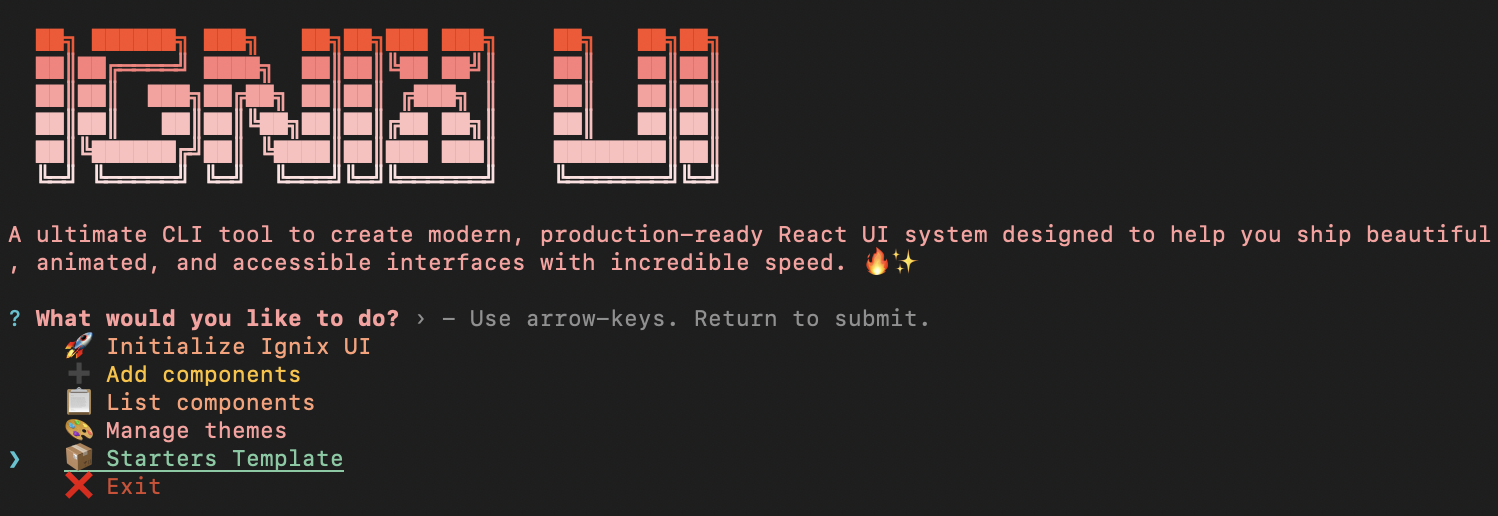
Then select Next.js App (App Router + TypeScript + Tailwind) from the list of available starters.

Skip the menu and scaffold immediately:
ignix nextjs-app
What the CLI does
- Verifies the target directory (warns if not empty)
- Writes
package.json,tsconfig.json,next.config.js - Configures Tailwind + PostCSS + Prettier + ESLint
- Generates
src/app,src/components,src/pages,src/styles - Injects Ignix
ThemeProvidervia a client-sideProviderscomponent - Creates
ignix.config.js,.gitignore, and a helpfulREADME.md - Initializes git and installs dependencies with your detected package manager
Generated Structure
.
├─ src/
│  ├─ app/
│  │  ├─ layout.tsx        # Root layout w/ ThemeProvider + metadata
│  │  ├─ page.tsx          # Welcome screen + starter checklist
│  │  └─ providers.tsx     # 'use client' wrapper around ThemeProvider
│  ├─ components/
│  │  ├─ ui/               # Ignix components land here (via CLI add)
│  │  └─ SampleComponent.tsx
│  ├─ pages/               # Optional legacy pages dir
│  └─ styles/globals.css   # Tailwind + CSS variables for light/dark
├─ ignix.config.js         # Registry + default component/theme paths
├─ next.config.js          # React strict mode + SWC minify
├─ tailwind.config.js      # Ignix-aware theme tokens & content globs
├─ tsconfig.json           # Strict TS + path alias `@/*`
├─ .eslintrc.json          # extends `next/core-web-vitals`
├─ .prettierrc             # Tailwind class sorting
├─ .gitignore              # Node/Next/Tailwind/Vercel ignores
└─ README.md               # Quickstart + scripts + structure
Key Integrations
- ThemeProvider:
src/app/providers.tsxwraps every page, enabling theme persistence, OS sync, and the IgnixThemeSwitcher. - Tailwind CSS: pre-wired with Ignix color tokens (
var(--primary)etc.) and content globs that includenode_modules/@mindfiredigital/ignix-ui. - TypeScript: strict compiler options,
@/*alias mapped tosrc/*,next-env.d.tsautomatically picked up. - Tooling: ESLint, Prettier, PostCSS, Tailwind, and git are all configured so
npm run lintandnpm run formatwork immediately.
Scripts
| Script | Description |
|---|---|
npm run dev | Starts Next.js dev server with HMR |
npm run build | Production build (next build) |
npm run start | Runs the built app (next start) |
npm run lint | ESLint using next lint rules |
npm run format | Prettier write with Tailwind plugin |
Next Steps
cd your-app && npm run dev- Add UI via
npx ignix add button - Explore themes with
npx ignix themes list - Deploy to Vercel / your platform of choice